← All templates
Where the Money Goes Infographic
An income, a budget or a bill split by what it pays for
Make the same video as the "Where the Money Goes Infographic" template on ultramotion.ai: https://ultramotion.ai/templates/where-the-money-goes/

If you can install skills, run npx skills add sunsiyuan/ultramotion first and use examples/us-dollar.html in skills/infographic as the starting point: copy it and keep the look, the pacing, the camera, the type and the music exactly as they are; only replace what is in 【】 below with mine. If the words are longer or shorter, change the size and the line breaks, not the structure. Use real data and compute every number on screen from the data file. If you can't install skills, make the same video as the one on that page from scratch.

My content:
- Which money: 【a federal dollar in fiscal 2025】
- Split by: 【what it pays for】
- Data source: 【…】

Deliver: Vertical 1080×1920, 30 fps, an mp4 with music, in the current directory.
Made at 9:16. For another size (9:16, 16:9, 4:5, 1:1), say so in the prompt.
More in this style
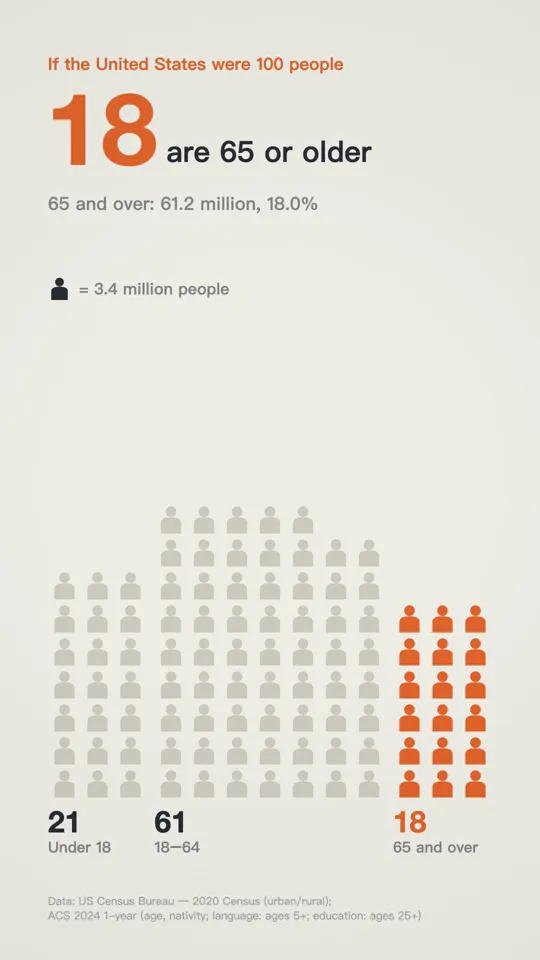 If It Were 100 People Infographic
The full prompt behind the first sampleEverything the first sample was made from, written out. Use it to make it from scratch, or to see how it is put together.
Make a video in the Infographic style from ultramotion.ai: https://ultramotion.ai/styles/infographic/
The style is an open-source Agent Skill. If you can install skills, run npx skills add sunsiyuan/ultramotion first and build it with the infographic template (units.js keeps one crowd of units and walks it through arrangement after arrangement, lights one group at a time, places numbers beside groups without collisions, draws the magnifying glass and moves the camera; render.py renders; sound.py scores it on sampled instruments). If you can't, write it from scratch following the description below.

[Deliverable]
- Subject: where a federal dollar went in fiscal 2025.
- Landscape 1920×1080, 30 fps, 42 seconds, an mp4 with music and sound, saved in the current directory.
- Every frame is a pure function of time t: where every square stands and what colour it is are computed from t, with no state carried between frames. Render with a headless browser frame by frame, encode with ffmpeg, then add the sound.

[Real data, with sources]
- U.S. Treasury, Monthly Treasury Statement for September 2025 (fiscal year 2025, Oct 1, 2024 – Sep 30, 2025), from api.fiscaldata.treasury.gov, no key: mts_table_9 (net outlays by budget function) and mts_table_5 (outlays by agency, for NASA). Save it as JSON next to the page.
- Total net outlays $7,009,973,667,049. The categories, from the budget functions: Social Security; Medicare; Medicaid & other health (the Health function); Interest on the debt (Net Interest); Military (National Defense); Income support (Income Security); Veterans; and Everything else — whatever is left of the total, net of offsetting receipts, named honestly.
- Compute every number on screen from the file in the page; round to whole squares by largest remainder so they add to exactly 100:
  · 1 square = 1¢ of every dollar, about $70 billion; the total, $7.01 trillion;
  · Social Security 22.5¢ ($1.58 trillion) → 23 squares; Medicare 14.2¢ ($997 billion) → 14; Medicaid & other health 14.0¢ ($979 billion) → 14; Interest on the debt 13.8¢ ($970 billion) → 14; Military 13.1¢ ($917 billion) → 13; Income support 10.0¢ ($702 billion) → 10; Veterans 5.4¢ ($377 billion) → 5; Everything else 7.0¢ → 7;
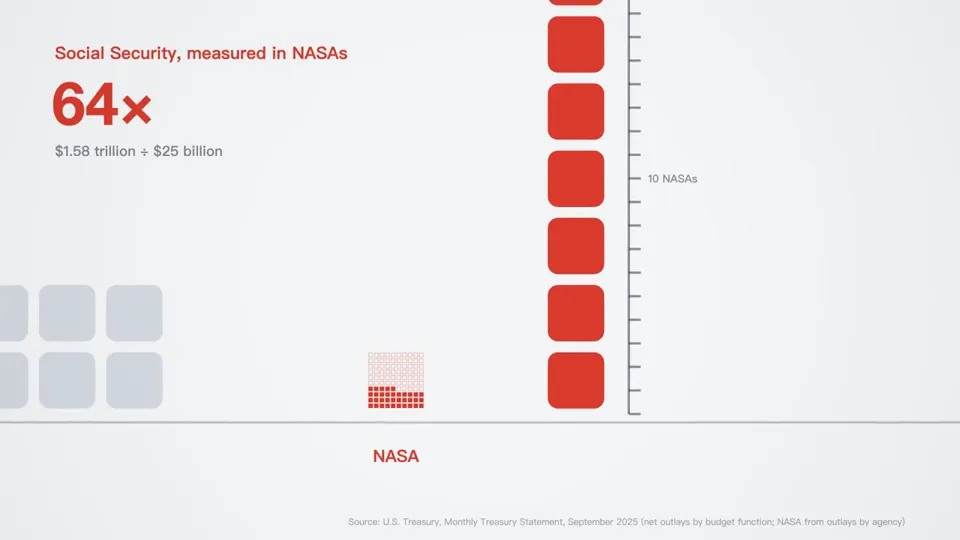
  · NASA $25 billion = 0.35¢: the last cent of Everything else is drawn as 10×10 small squares, 35 of them filled;
  · Social Security ÷ NASA = 64×.
- Bottom right, small: "Source: U.S. Treasury, Monthly Treasury Statement, September 2025 (net outlays by budget function; NASA from outlays by agency)".

[The same crowd, re-formed for every question — this is the style]
- It is these 100 squares from start to finish; only where they stand changes. When they re-form, each square walks from where it was to its new place on its own slightly curved path, leaving a little after its neighbours, landing with a small give. No slides, no cards, no summary page — one continuous shot over a floor (a thin line at y 900), the camera moving inside the same world.
- One group lit at a time: the group being talked about turns the one red, the rest go pale grey, its number beside it.
- The timing:
  · From 0.3 s: 100 squares drop row by row into a 10×10 block standing on the floor at the right (centred at x 1300), done in about 1.5 s; the NASA square lands last.
  · 4.8 s: they walk into eight piles side by side on the floor, three squares wide, sorted largest first with Everything else last. From 6.0 s the cents (bold) and names sit under every pile. 6.0–11.6 s Social Security lit.
  · 12.4–18.2 s: Interest on the debt lit — and you can see it is taller than the Military pile beside it.
  · 19.0 s: the last cent of Everything else lights (and stays lit to the end). At 19.6–20.4 s a magnifying glass swings in from the upper left and settles above it (radius 190, ×5.1, the whole cent inside the glass), showing the 100 small squares and NASA's 35 filled from the bottom row up. Beside the glass, right-aligned: "1 square = 1¢", "NASA = 35 small squares" in red, "0.35¢ of every dollar". The glass leaves at 25.8–26.4 s.
  · 26.6 s: the other piles step back to the left; Social Security's 23 squares stand up as one single column at x 1720, with NASA's cent alone on the floor beside it at x 1570. From 27.4 s Social Security is lit too.
  · 27.0–28.8 s: the camera drops to the floor beside them (×2.4, low); holds to 30.0 s. From 29.0 s a ruler runs up the right side of the column with a tick for every NASA (one NASA = 0.35 of a square) and a label every ten ("10 NASAs", "20 NASAs" …); "NASA" written small under the cent.
  · 30.0–33.4 s: the camera climbs the column at a steady speed to its top, "Social Security" written there; holds to 35.0 s.
  · 35.0–37.0 s: the camera pulls back out to the whole floor; the column runs off the top of the frame. Hold to 42 s.

[Say the finding, every beat]
- Top left: a small line, a huge number under it, a grey line under that; each fades in over 0.5 s rising a little and fades out 0.4 s before the next:
  · 0.5 s: "Every dollar the U.S. government spent in fiscal 2025" / "$7.01 trillion" / "Federal outlays, October 2024 to September 2025"
  · 6.0 s: "Social Security" / "22.5¢" / "$1.58 trillion, the largest single share"
  · 12.4 s: "Interest on the debt" / "13.8¢" / "$970 billion, more than the military's 13.1¢ ($917 billion)"
  · 19.0 s: "NASA" / "0.35¢" / "$25 billion: 35 of the 100 small squares in one cent"
  · 29.4 s: "Social Security, measured in NASAs" / "64×" / "$1.58 trillion ÷ $25 billion"
  · 36.4 s, the end, in two large lines and no number: "Of every dollar: 22.5¢ to Social Security, / a third of a cent to NASA"
- The unit stays on screen: from 2.4 s, under the header, a square and "= 1¢ of every dollar, about $70 billion" (it leaves when the camera moves in).

[How it looks]
- White paper: ground about #f3f4f6, squares at rest in navy ink (about #1d2742), squares not being talked about pale grey (about #d3d7df), the lit group red (about #d93a2b), quiet text in translucent ink. No other colours.
- The units are rounded squares, all alike, no outlines.
- Three type sizes: the number huge (120 px, heavy), the line over it 34 px bold (red once a group is lit), labels, the arithmetic and the source small and quiet. Numbers sit under their piles, not in a legend.
- Light grain over everything and the faintest vignette.

[Sound]
- Light, on piano and plucked strings: a held piano chord on every re-forming — E minor at 0 s, C major at 4.8 s, A minor at 12.4 s, D (open fifth) at 19.0 s, B at 26.6 s, C major at 29.4 s, E minor at 35.0 s — with a plucked figure an octave up every 0.67 s over it, except while the column stands and the camera moves in.
- Up the column, 30.0 s on: a rising pluck line, one note every 0.24 s, fourteen notes climbing from E3 to D5, a little louder as it climbs.
- A high celesta note when each group lights: 6.1, 12.5, 19.7 s; another at the top of the column, 33.6 s.
- A soft tap as each square lands, merged into a patter; a whoosh under the camera move in (27.1 s) and back out (35.2 s).
- No drums, no orchestra, nothing pulsing with a beat.

[Check before you hand it over]
- Pull a frame inside every arrangement and one inside every move (for example 2, 8, 15, 22, 28.5, 32, 34.5, 39 s) into one contact sheet; open one full size.
- Squares only changing colour in a fixed grid: move them into a new arrangement for each question.
- Every group coloured at once, with a legend: light one, grey the rest, number beside it.
- The NASA sliver invisible: the glass must fit the whole cent so all 100 small squares can be counted.
- The tall column squeezed to fit the frame: let it run off the top and climb after it.
- Any number on screen not computed from the data file, or without a source.
- No unit on screen: "= 1¢ of every dollar" stays up until the camera moves in.